About Me

I'm a writer, translator and aspiring director. Occasionally, I actually do some work instead of using this blog as a displacement exercise.
Showing posts with label film review. Show all posts

Tuesday, 28 February 2012

DR. NO - "Just a stupid policeman"

The shadow of Hitchcock hangs heavy over Dr. No, and not just in a literal sense. With the Master of Suspense having been sought as the perfect director for the Thunderball project, it seems inevitable that there would be a resemblance between his work and any consequent James Bond film. North by Northwest is very much the codifier for many of the secret agent tropes that would later become associated with the Bond films - the suave, charming leading man, the softly-spoken and cultured villain who offers his services to enemy powers, a bracing musical score and stylishly designed opening titles.
Saul Bass was Hitchcock's favoured artist, and his legacy can be easily detected in the animated sequence produced by Maurice Binder. Starting with the famous gunbarrel sequence, with electronic noise and the credit "Harry Salzman & Albert R. Broccoli Present" added to the tracking white circle to leave the ampersand picked out, it segues immediately into a sequence of dots and film strips. Beautiful, elegant, irrelevant, showing its heritage and a sign of the future.

Cary Grant as James Bond.
"They were on their
way to a funeral."
The film opens with the murder of Strangways, MI6's man in Jamaica, and his secretary by a trio wielding silenced pistols. It is important to watch this in the context of its time - Kennedy is still in the White House, the Beatles were still almost unknown and Vietnam was only a distant blob on the map. Seeing two defenceless people repeatedly shot for no apparent reason would have packed a serious punch at the time, and the level of violence the film permits will frequent this level.

MI6's radio room detects a dead line, and the message goes out that something is wrong. The sight of the inside of Bond's place of work is peculiar, more like an office than a secret organisation. This curiosity is repeated when Bond arrived for his briefing, which appears to indicate that M's office is in rented space inside another building.

Bond is summoned at his club, where his is engaged in a game of baccarat with the beautiful Sylvia Trench, but in a neat trick, we do not see his face until he formally introduces himself to her. That first utterance of "Bond. James Bond", as the theme quietly kicks in in the background, is clearly intended as an iconic moment, and five decades later still packs a punch. Rather more startling is the reveal that Bond carries a business card, which he passes to Miss Trench. A little careless for a secret agent?

Bond's briefing reveals that Strangways had been investigating the "toppling" of American missiles
being launched from Cape Canaveral - a super-topical subject in the year of the Cuban Missile Crisis, so Bond is to be dispatched to investigate his disappearance. First he is to be outfitted with a new firearm - his previous one he apparently wore to the gaming tables earlier.
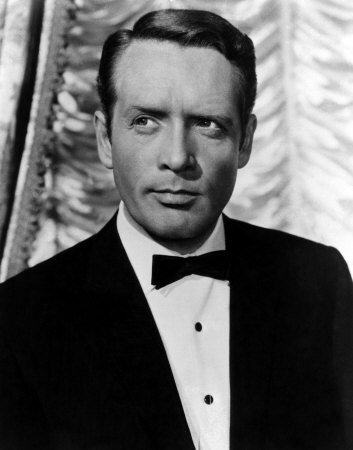
Patrick McGoohan as James Bond.
"Tell me, does the toppling of American missiles
really compensate for having no hands?"
This little scene offers some background to Bond. He has used his current weapon, a Beretta, for a decade, and was previously assigned to standard intelligence duties. M is less than impressed with its tendency to jam, while the armourer flatly calls it ideal "for a woman's handbag". Dialogue also indicates that M has not been long in his post, which might explain his obvious dislike of Bond, something that was not noticeable in the books.

Bond returns to his flat to pack for his mission, but find Miss Trench waiting for him. The shock of actually seeing the inside of Bond's home covers the rather startling matter of Sylvia a) having his address from his business card and b) getting in without any trouble. I appreciate that in olden days people could leave their doors open and not worry about burglars, but spies are traditionally expected to have some security against passing opportunities, especially since Sylvia looks and acts exactly as a honey trap would. Maybe Bond is known as something of a liability, and M wants him in Jamaica where he can do the least damage.

Bond flies to Kingston via that luxury brand Pan Am, presumably served by Christina Ricci on the way, and wanders through the arrivals lounge accompanied by the theme music - the first of a number of inappropriate uses during the film, as though being in an airport were an impossibly thrilling experience. On the other hand, this was 1962. Most people still hid from the Moon.

Bond's driver picks him up, but he quickly deduces that he is an enemy and they have a fight. A poisoned cigarette allows the driver to take the easy way out without talking, much to Bond's surprise, but darker than this is Bond driving up to Government House with the corpse in the back seat and bounding inside, telling the commissioner as he goes "Don't let him get away."

For much of the film, Bond acts more as a detective than a spy, giving him more in common with pulp fiction private eyes than the cliffhanger serial action men or comic-book superheroes he will later more closely resemble. His first suspect to pursue is Quarrel, a local who assisted Strangways in examining offshore islands, and their awkward conversation is unusual for its near-documentary tone.

Monty Norman was hired to provide the music for the film, and based much of it on popular Jamaican rhythms as well as cannibalising a song from an unproduced musical for the James Bond theme. These scenes, of Bond gently questioning and then tailing Quarrel, are notable for their lack of music and restrained sound mix - a major contrast to later example of the genre Bond would spawn. The use of local music, rather than more generic action themes, creates a distinctive atmosphere that in some ways has dated the film, but also allowed it to remain timeless. It exists as an example of a road not taken.

Quarrel turns out to be working with Bond's American opposite number Felix Leiter, so the men pool their resources after a brief fight. One strange detail is comment about Quarrel’s friend Pusfeller, owner of a bar when the men meet. Quarrel mentions that he was tough in the fight as he's used to wrestling alligators. Not, as the book notes, octopuses. At the bar, Bond is filled in on Strangways activities, including stealing some samples from a private island named Crab Key to be tested by local geologist Dent.

Bond spots a woman taking his picture, having previously done so at the airport, and she is intercepted. Quarrel twists her arm to explain who she is, but she does not relent. Again, the violence on display is tough for its time, especially Quarrel’s casual suggestion that he break her arm. In light of Sean Connery's comments in favour of a little domestic violence now and then, this is uncomfortable viewing. Bond muses that whoever is behind matters must be very intimidating to provoke one employee to suicide and another to a broken arm, wondering what there can be on Crab Key that is so valuable. Leiter says that there is little other than a bauxite mine operated by the island’s owner - a certain Doctor No.

Bond visits Dent to ask about the samples, but he says that they were just worthless rock and has since disposed of them. Unconvinced, he uses a Geiger counter the size of a suitcase to test the floor of Quarrel’s boat and deduces - more detective work again - that the samples were radioactive. Someone is operating a large scale nuclear reactor at Crab Key.
He has people killed by locking
them in and waiting for it to rain.
Dent, sweating more than ever, takes a boat to the island where he is shown into a room seemingly annexed from a silent German horror film. This is first true sign of the signature James Bond set design, courtesy of Ken Adam, with Dent perched on a chair in the room's furthest corner - all the better to make him seem small and weak. He discusses Bond's progress with a softly-spoken off-screen presence and is given a large poisonous spider to use for his assassination.

The expressionist style of this set reminds one of such works as The Cabinet of Dr. Caligari, but more of Dr. Mabuse. Essentially a nightmarish German version of Professor Moriarty, Mabuse was the emperor of global crime, controlling a seemingly bottomless empire. A modern-day analogue would be that of Keyser Soze - the near-mythical crime lord whose underlings would rather commit suicide than disappoint, and whose presence is only suggested and implied.

That night, Bond finds something unwelcome in his bed, but the sharp-eyed viewer will not miss the thick pane of glass between Sean Connery and the spider, due to the actor's arachnophobia. Had the film stuck to the book, Bond would have been menaced by a centipede with enormous pincers crawling towards his groin. After crushing the spider with his shoe, Bond goes into his en suite. The reason for this in the novel is simple - there are insect guts all over the carpet and he needs to throw up.

Having discovered that the files on Doctor No and Crab Key are missing from Government House, Bond decides the best course of action is to make a date with the secretary at the isolated house. No wonder M's suspicious about him. Bond gets another rendition of his theme as he drives around the countryside, but converse to expectations this cuts out as he finds himself pursued by the silencer gunmen. A flick of the wheel sends their hearse over a steep drop, where it bursts into flames for no apparent reason. The killers' choice of a hearse allows Bond a further black punchline - "They were on their way to a funeral."

Having arrived at Miss Taro's bungalow - giving us another rendition of the theme - Bond turns on the charm and talks her into bed in only a few minutes. Again, the surrounding circumstances would blot out this feat, namely that Bond is kissing, with no little enthusiasm, a mixed-race woman. Shocking stuff for 1962, I imagine. Bond checking his to see if he has time for a quick is less than chivalrous.

Not pictured: Bond jumping up and down on his head.
As if we hadn't guessed, Miss Taro is working for Dr. No, and the police take her away leaving Bond to wait for another attempt on his life. Dent turns out to be less than up to the job, emptying all six shots into a pillow and allowing Bond to return the favour. In the finished version of the film, Dent is only shot twice, but the original version sees Bond empty his gun into the prone geologist's back. Perhaps a little too far that time.

Bond and Quarrel set off for Crab Key, as the story shifts gear from part-travelogue, part-detective story to something akin to a paranoid thriller. Quarrel drinks for courage, which is a delightful racial stereotype, while Bond hears singing coming from over the next dune. The sight is that of Venus rising from the waves in the form of a dubbed Swiss model. Bond actually joins in with the song as a means of announcing himself, which is a pretty smug thing to do. The version of Ursula Andress in her pristine white bikini may be one of the reasons why the Vatican issued a communiqué formally disapproving of the film, although they would probably count themselves lucky they didn’t follow the book, where Honey Ryder wears a belt for a knife - and nothing else.

They seek cover as a boat patrol passes, taking a few potshots at them as they go. Fully informed that Bond is coming, No's organisation seems more monolithic and all-powerful than ever. Adding local folklore that there is a dragon on the island to the mythical build-up that the title character has received would explain why I found the film so frightening when I saw it on Anglia Television in the mid-80s. I distinctly recall being sent to bed early, although I may have been naughty on that occasion, attempting to colour in the wallpaper, perhaps.

Bond's reaction to the story of the Dragon is less respectful than mine was, with the look on his face
indicating that he feels he's surrounded by idiots, or at least people he can patronise for their opinions. He sends Quarrel to fetch his shoes for him before they head inland, passing a skull and crossbones sign on the way, again reinforcing No as more of a force than a person.

Stopping to rest, Honey tells Bond her story, including how a man who looked after her after her father's death raped her and she got her revenge by... putting a spider in his bed. It's hard to see which part of this story worries Bond more, but he shrugs it off with a quip. This puts the film's sexual politics in an odd light. Though violence against women can be justified, as with the photographer, the indication is that the agonisingly protracted death of Honey's rapist was deserved. Again, remember that in 1962, the UK still had a death penalty. Even if rape was not a capital offence, the judgement could be at the time that Honey was serving the public good in shorter order than normal. It's somewhat telling that the scene ends with Honey asking Bond if he is single, and his being rather tongue-tied.

Night falls, and the trio finally encounter the dragon. The image of the strange vehicle in the dark landscape of brush is another intimidating and moody one. The dragon is revealed as an armoured car carrying searchlights and a flamethrower. The latter is used to dispose of Quarrel in suitable grisly fashion before the truck disgorges a number of faceless figures in radiation suits. Bond and Honey are bundled inside and taken inside Doctor No's base. It is at this point that the film makes its final jump across genres, venturing into science-fiction.

Bond and Honey go through decontamination, having been wandering around the island's radioactive environment, and are sent into the heart of the base - a weirdly comfortable spa resort-like group of suites, staffed by cheery nurses that fuss over them and their delayed arrival. Invasion of the Bodysnatchers was a few years distant as they are shown wardrobes filled with clothes that fit perfectly and are invited to dine with Doctor No that evening, just as soon as they recover from the knock-out drops in the coffee they've just drank.

On the way to dinner, Bond reassures Honey that he too is scared, showing that the antagonist’s self-conscious myth-making is getting to him. The same could go for the audience, not knowing what to expect when they encounter the mysterious mastermind who engenders such fear from his own underlings.

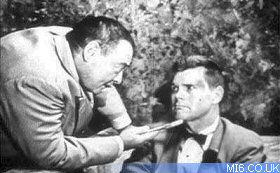
Noel Coward as Doctor No.
"You were wondering how much it cost.
One million dollars"
Doctor No himself finally introduces himself, a full 20 minutes from the end of the film, and it is hard to know what to make of the man. Small, slight and with quiet intense manner, Bond immediately starts ripping the piss. The agent receives his very first dry martini, "shaken, not stirred" - informed perhaps by the staff at Bond's hotel? - and proudly describes how the island set up cost him the gargantuan sum of $10 million, stolen from his previous employers in a Chinese Tong society. This figure equates to a cool $75 million in 2012 money, but the island operation still seems a little more expensive than that. Perhaps No is financing himself with that bauxite mine. In the book, the island's bird population was a rich source of guano, sold on at enormous profit.

Having taken note of No's possession of Goya's portrait of Wellington - stolen shortly before production commenced - Bond continues to try to break his captor's facade with barbed remarks about No's metal hands - the result he says of his own unique experiences with radioactivity, while No boasts of his own employer. SPECTRE is the Special Executive for Counterintelligence, Terrorism, Revenge, Extortion, and No wants Bond to apply for a job, possibly in the acronym department. Bond is less interested in this, provoking No to dismiss him as "just a stupid policeman". This may well hit home, moving Bond to ask if "the toppling of American missiles really compensates for having no hands?" The idea that a Bond villain’s actions are compensation for some other shortcoming will reoccur. No is quick to shoot down Bond's own comments about those believing themselves to be God or Napoleon, but the latter seems rather accurate, what with the prize in his gallery.

Growing tired of his guests, No sends Honey off to "entertain" the guards. The inference is obvious, and Bond leaps out of his chair to defend her as she screams for help. A gun to his head dissuades him from acting further, but this fate seems especially cruel for Honey given her past experience. Given that they know her dress size, why might not they have also overheard her earlier conversation with Bond, tailoring a torture just for her.

This fits with the book's portrayal of Bond's ordeal. He is locked in a cell with a single ventilation grill leading into a maze of eerie echoing narrow tunnels. In the book it is made clear that this is a test to examine Bond's physical endurance, as he is given an electric shock taking off the metal grill before nearly falling to his death, being boiled in a red-hot pipe and then almost drowning. The film makes no comment towards No's sadism, simply forcing Bond to jump through some contrived hoops to escape.

The tunnel exit leads to No's control room and Ken Adam's piece de resistance, the inevitable reactor room set. No is about to topple anther missile, but Bond steals a radiation suit and intervenes, overloading the reactor. Extras mill around as alarms sound and the reactor pool starts to steam, and the audience starts to see where Mike Myers gets some of his ideas. There is another noticeable lack of music as Bond and No fight on top of the platform sinking into the now-boiling pool, with Bond climbing out at the last moment, but No's metal hands fail to find purchase as he sinks beneath the surface, expiring in his radiation suit like so many boil-in-the-bag meals before him.

The book offers a different demise, as Bond commanders a crane on the island's dock as No supervises another shipment of guano, allowing him to slowly dump the contents on the Chinese villain, first immobilising him and slowly letter the pile rise like quicksand until he is completely covered and unable to escape. "You're up shit creek", Bond probably says.

As bits of Doctor No’s base explode, Bond frantically searches for Honey, and some of the minor players are allowed moments in the sun. One beleaguered guard knows nothing and scrambles to get away, while the friendly nurse is dragged from her packing by Bond, who finds Honey staked out over slowly rising inlet. The original intention was for her execution to be by giant land crab, but Honey knew that staying still would act as a deterrent and they would lose interest. The crabs shipped from Jamaica to the studio arrived packed in ice and frozen solid, leaving to half a page being torn from the script. Oddly, there is no mention of her "entertaining" the guards. Maybe the crab spectacle was enough for them and they too became bored and wandered off.

Bond and Honey make their escape in a small boat - whose passengers Bond throws in the sea - as the complex is annihilated by a very large and realistic-looking explosion. They are soon picked up by Felix, who seems entirely unconcerned about the mushroom cloud now hovering over a major British colony, and hunker down in their little craft for a little R&R as the James Bond theme blares a final time and a very brief end credit sequence is accompanied by the bloodied gunbarrel from the opening titles.

So what of the film as a whole? Sean Connery's presence eats up the screen wherever he goes, and Joseph Wiseman is subtly menacing as Doctor No, although the decision to yellow him up for the part could have been avoided since the character is stated to be half-German. The production looks notably cheaper than the smash hits of the time - it cost less than Elizabeth Taylor was paid to star in Cleopatra - and seems much smaller is scope and scale virtually all later outings.

Nevertheless, it is supported by a well-structured script, albeit with a number of holes due to the precedence of crowd-pleasing content over internal logic. The repeated attempts on Bond’s life look a little clumsy, hardly the work of a mastermind like No, while Honey notably performs no function in the script other than to be gorgeous and to avoid having Bond snog Quarrel at the end of the film. It's a promising start, all in all. And takes less time to watch than it took to write this article. 

JAMES BOND WILL RETURN
IN
"FROM RUSSIA WITH LOVE"

Friday, 13 January 2012

CASINO ROYALE (1954) - "I'm the fella that was missed"


Barry Nelson as James Bond.
New Year's resolution, whatever.
The first stop in the slightly-delayed Year of Bond is the 1954 television version of Casino Royale. Produced for the anthology series Climax! broadcast on CBS, it was the result of Ian Fleming selling the rights to the first Bond novel to the network for $1,000. It is also interestingly weird for anyone used to the films i.e. residents of the planet Earth.

The film starts with an introduction from the series' host William Lundigan, who takes the time to explain what a baccarat shoe is, but declines to elucidate on the actual rules of the game. The show begins with a title sequence shot down the barrel of a television camera, which adds an appropriately Bondian feel.

The play - and it is a play - begins with someone attempting a drive-by on James Bond of the American Combined Intelligence Service as he arrives at Casino Royale, which he foils by hiding behind a pillar, and then meeting with his contact, British agent Clarence Leiter. Already it seems like we have jumped head-first into a parallel existence. One can understand Bond becoming American, having an awful haircut and even swapping the nationalities, but Clarence? Really? Matters are not helped by his enormous Adam's apple, which looks like he's swallowed an egg.

Barry Nelson was cast as Bond, but may be better known for his supporting role as Ullman, the manager of the Overlook Hotel who interviews Jack Nicholson and shows his family around in The Shining. He's a capable Bond, but looks ill at ease, and fails to give much indication of the man's personality. In fairness to him, the script gives him little with which to work, and even in the book Bond is incredibly taciturn.

He's supposed to be facing the
other way, and walking to the left.
The live nature of the production is betrayed by the action scenes. The opening play for Bond's life is incredibly stagey, and the use of wide angles quickly saps any tension. This will be a recurring problem. There is the first sign of neat writing, with the first meeting of Bond and Leiter starting to actually explain the rules of the game, whilst dropping a few more mindbenders. Apparently, Card Sense Jimmy Bond is a bit of a celebrity, pre-empting the world-famous spy of the later Roger Moore films.

As they repair to the bar to remember their next lines, Peter Lorre is introduced as Le Chiffre. He is perfect casting, looking more like a Bond villain than should be humanly possible, and he has in his employ Valerie Mathis, an old flame of Bond's. Again, there is some deft writing in combining two characters from the book to create something new, while seemingly fulfilling the film noir trope of the girl in the villain's employ taking a shine to the hero. We can already guess that the twist at the end of Fleming's book, that Vesper Lynd was working for the Russians all along, will perhaps be somewhat different here.

Bond and Leiter get acquainted, with Leiter briefing Bond under cover of the latter explaining the game. However, some of the over-the-shoulder shots of Leiter are marred by the sight of Bond's huge neck bulging over his shirt collar, while Leiter notes that Bond won't have to kill Le Chiffre, "if you play your cards right". You get nothing for a pair in this game, so Bond is to clean out Le Chiffre, who is paymaster for Soviet spies in Western Europe.

Even the book says he looks like a toad.
Le Chiffre even has his own Bond villain trademarks, keeping three razor blades on his person as weapons and being constantly accompanied by three bodyguards. Unfortunately, the one called Basil isn't the one who looks like John Cleese. Valerie introduces herself to Bond, who tries to smooth it out in a Cary Grant style as they go to her room. After catching up on a little lip action to some deafening Chopin, Bond reveals that he knows she's working for Le Chiffre and that he's listening in, and tries to turn her to their side while the toad-faced Commie and his cadre of cads try to listen in upstairs.

As Leiter collects the money for tomorrow night's game, there's some amusement to be had at the colossal, paperback book-sized banknotes. One of Le Chiffre's men tries to mug him, when the phone next to them rings. When the manager reaches to answer the phone, Leiter says that it's for him, oh and by the way, could you hold onto this money for Mister Bond? Thank you so much.

Bond picks up the money and proceeds to the game. A call comes through threatening Valerie's life if Bond wins, but he is not to be put off, and settle down at the table. Then we finally break for the first commercial, nearly halfway through the play. Remarkably, everything so far has been played out live and in real time. The only stumble I noticed was when the shadow of a boom microphone follows Bond to the lift.

He's black now, but they didn't find
it necessary to change his name.
The staging of game sequence is disappointingly artificial in the camerawork, with the director favouring long, static medium shots in favour of anything more dynamic. This may simply be a symptom of how television was produced at the time, but the atmosphere is helped by the near total silence, broken only by the croupier's perfunctory dialogue and the occasional gasp from the watching extras. Lorre's performance is perhaps a little too theatrical here, as he favours big movements in sliding the cards around.

Chiffre. Lorre's exit from the table is marvellous, casually saying to Bond, "Well...", and smiling before standing up and barging his way through the observers. The Cleese-alike uses the distraction to poke his cane into Bond's back, revealing it to be a gun, and says he will shot Bond in the spine if he doesn't hand the money over. Bond shoves himself away from the table and gets away, but Valerie has been kidnapped by Le Chiffre's two remaining men.

Bond picks up the cheque for his winnings and secrets it in his room by unscrewing the number plate on his door and squeezing it in behind that. He is helped in this by the enormous spotlight that shines over his shoulder. Le Chiffre arrives moments later, revealing that he knows Valerie work for the Deuxieme, the French Secret Service.

Another commercial, and Bond's been roughed up, but still refuses to give in. You know what that means? They put him in the bath and take off his shoes and socks. Ooookay. Then Le Chiffre pulls out a pair of pliers. What happens next occurs just out of frame, but it seems like pretty tough stuff for the early 50s. Bond is typically intransigent, even if he sounds more like a hard-boiled PI than the famous Simon Templar.

Be honest. You're glad it's not the bit with the knotted rope.
Somewhat carelessly, Le Chiffre has left his cigarette case in easy reach, and Bond uses the razor inside to cut himself and Valerie free. His escape starts to get ridiculous as he fights Basil in the most unconvincing fight in TV history, effectively slapping his arm until he falls down. Le Chiffre follows to investigate and is shot twice. He slumps in a chair, palming the razor from his hat. Bond tells Valerie to call the cops and then...

Um, we go to the end credits. There appears to be part of this missing, especially as the third henchman was sent to intercept Leiter and never comes back. I imagine that Bond wins, though frankly I wouldn't be surprised if he dies of toe injuries.

The real first James Bond. Although
he'd have been a great George Smiley.
The production as a whole is reasonably effective, and makes use of few sets and actors. For its time, it seems an entertaining 50 minutes, and its only with 50 years of film adventures between then and now that something feels wrong. The changes made to the text for timing are understandable, but it's the odd switches in characterisation and tone that stick out. The story ends up feeling more like an am dram film noir than any other incarnation of Bond; even the novel has a more pessimistic European tone. An oddity, and an interesting one, but not necessarily worth your time.

JAMES BOND WILL RETURN IN "DR. NO"

Friday, 4 November 2011

The Teaser

Yes, me again. Disappointing, isn't it?

I've had a pretty quiet summer. My main activity appears to have been gaining weight, thanks to the assistance of a semi-competent personal trainer who had no idea what she was doing. My original trainer is back now, and the weight is sloughing off like skin from a burn victim. She's getting a Christmas present. Patience of a saint, that woman.

The other thing I've been up to, surprise surprise, is watching DVDs, and I've managed to make a big dent in the pile as a consequence. Which has since filled up again with new discs - apart from the copy of if... which never turned up from the Amazon vendor. A circle of hell is reserved for him.

The thing I haven't been doing is maintaining this blog, principally because I have really struggled to think of topics to write about. So, I've had to make something up. I'm going to do a marathon.

Not a running marathon. That would be insane. A DVD marathon. Inspired by the wonderful Adventures with the Wife in Space, I will be undertaking that great right of passage for any true Englishman - I will be watching the James Bond films in order over the course of a year and blogging about them. And possibly livetweeting; I haven't decided yet.

As was announced yesterday, the new James Bond film, Skyfall, will be released at the end of October next year. This will be the 26th screen outing for 007, counting the 23 regular films, the 60s version of Casino Royale, the lawsuit-enabled remake of Thunderball, Never Say Never Again, and the little-seen 50s TV version of Casino Royale. I will be starting in two weeks time, and watching one film every fortnight, leading up to the release of Skyfall, and will try to post as soon as possible my thoughts and comments on each film.

I've been a huge Bond fan for many years, and cannot in fact remember a period when I hadn't seen one of the films. In the spirit of full disclosure, I should say that this isn't the first time I've done this. ITV ran all the films in 1999, conveniently slotting them around my exams, and when I first acquired the DVDs I ran through them from late 2003 to spring 2005. I'd be interested to see if there is any change in my opinions, as well as appending the Daniel Craig films to the equation.

To try to give the postings some kind of structure, I'm thinking of putting in some regular categories that might not have appeared in previous similar compendia. Already, I feel that listing the moments when Bond does something weirdly out of character ("Bond bakes a quiche"), or just weird ("Bond locks a midget in a suitcase"). Any other suggestion would be appreciated. There will also be the usual succession of interesting facts and remarks about how closely each film resembles the source material. A fun visual game will be adding pictures of those nearly cast, with a line of dialogue as a caption so you can imagine them saying it. That does sound like fun, doesn't it?

First off the blocks will be the 1954 version of Casino Royale, a 50-minute production broadcast live on American television. Hopefully, the review will be online sometime on Saturday 19 November. Wish me luck. A final note of oddness. At my place of work I recently saw someone reading this blog. It was the entry about last year's Christmas party and my subsequent blackout. Perhaps I've found the culprit. Yes, you. You will never know when I will strike, and you will never hear me coming. But I will have my revenge. Oh yes.


Wednesday, 15 June 2011

Ants in Their Pants

Remember how I said I was going to write about something cheerful. I lied. In fact, I lied so hard that if you are remotely squeamish, you shouldn't read this post. It's about a banned film and will contain graphic descriptions of its content. I don't want to upset people unnecessarily, so if you find the Saw movies more than you can handle, please stop reading now.

The pictures, by the way, act as a safety valve. If the article gets a bit much, just cast your eye over to them and remember that what I'm writing about is fiction, while the pictures are all real life. Comforting, isn't it.

Last week, the British Board of Film Classification took the rare step of refusing a certificate to a film submitted for DVD release. The film in question is Human Centipede II: Full Sequence, a sequel to last year's cult horror. The first film rapidly gained notoriety in horror circles from festival screenings, with word of mouth leaking into the mainstream press, due to its central idea. A mad surgeon kidnaps three people and sews them together, mouth to anus, to form a "human centipede". Those who have seen the film attest that the film is significantly less shocking than that capsule description implies, but there is still capital drawn in the film from the suffering and degradation inflicted on the characters. In particular, the surgeon character takes special pleasure when the inevitable occurs and the man at the front defecates into the mouth of the woman behind, with the latter forced to swallow to stop herself choking to death.

In the film's denouement, investigating police catch the surgeon in a firefight, leaving all sides dead. With the man at the front having cut his throat and bled to death, while the woman at the back has expired from blood poisoning. This leaves the woman in the middle the only survivor, alone and helpless in a house in the middle of nowhere and surgically grafted to two corpses.

The sequel picks up the unusual idea of someone watching the film and being sufficiently aroused by it to want to make his own version. He is able to kidnap 12 people, joins them together as in the first instalment, and films the results.

The reason the BBFC declined to certify the film is the nature of the fan's behaviour. He is shown watching the first film on DVD while masturbating with sandpaper, and later becomes aroused by the coprophagia forced upon his victims. Ultimately, he wraps a length of barbed wire around his penis before raping the woman at the back of the 'centipede'.

These various acts are, according to the BBFC report, portrayed from the obsessive's point of view, meaning that the audience is encouraged to agree with his attitude that people are nothing but vessels for his own entertainment and that the brutalisation and humiliation of his victims is a source of sexual gratification.
I'm sure that you're starting to guess where the problem lies.

More specifically, the BBFC stated that two pieces of legislation are of concern. The Video Recordings Act 1984 states that the effect a work has on its audience must be taken into account, namely whether it is capable of inflicting psychological harm on a viewer, such as by encouraging a dehumanised view of others, and harm on society by extension. The Obscene Publications Acts 1959 and 1964 may provide grounds for prosecution under UK law for the distribution of such material. The BBFC elected to play safe and refuse a certificate. The distributor, Bounty Films, has six weeks to lodge an appeal, something it is currently working on.

That's enough facts. This is supposed to be an editorial. I've noticed that opinion online regarding the entire situation has trended towards outrage that the BBFC dares to act in such a censorious manner and restrict what consenting adults are allowed to watch. In fact, this is also the line adopted by Tom Six. He has commented that since the film contains no actual violence, it should be released as it is. He has also made some depressingly unoriginal comments about the UK being repressive, while I noted that others have taken the right-on stance of "yeah, but what's the real horror film? This or BBC Parliament? Enjoy living under the spoonfeeding tyranny, losers!" Mature debate, I'm sure you'll agree.

But amidst all the poseur idiocy, the question of whether or not an artistic work - and it is artistic, whether you like it or not - should be banned if no harm was done in its production. The film has been made to serve a market. A very lucrative one, judging by the amount of straight-to-DVD horror released each week. People don't take kindly to being patronised and being told that something will deprave them, so this reaction is entirely understandable. But at the same time, there is a voice gnawing away inside me saying that this sort of thing is repulsive and shouldn't be allowed. What sort of enjoyment can be gleaned from this? It seems as though it would be entirely prurient, gloating over the horrific ordeal of made-up characters. But if a person wants to watch it, surely the choice should be up to them, no matter how revolting the material.


So while the BBFC cannot afford to allow the public to "make up their own minds", since one of those minds might be unbalanced, it still has be prudent in allowing leeway for doubt and artistic licence. A Serbian Film, released in cinemas and on DVD last year, contains scenes that would make Tom Six blanch, but the film is intended as a political allegory of living in the former Yugoslav republic. In deciding to pass the film with over four minutes of the most extreme material removed, including cuts to a scene in which a newborn baby is anally raped, the board took this into account, citing its own remit to consider the makers' artistic licence and intent. The BBFC appears of the opinion that such an argument applies to Human Centipede II. It may be an artistic work, but that doesn't mean you can do what you like and claim your muse told you to do it.

Another factor in the decision, one which requires fewer examples of nightmare fuel, is whether the BBFC even has a role anymore. This is first time that a film has been refused a certificate since 2009, and then it was for similar reasons, but technology has progressed markedly since even then. Torrenting and the importing of Blu-rays means that those who want to see the film will be able to do so anyway, so the lack of a certificate seems to only be blocking the film from those would either stumble upon it or are not interested in seeing it anyway.

The other, more obvious element, is the date on the Obscene Publications Act. When it was last reformed, it was only three years after the notorious Lady Chatterly's Lover trial, when the prosecuting council asked the jury whether it was the sort of book one would want one's servants to read. This badly needs to be reformed, if only to keep pace with changing social trends. Remember that homosexuality was still a crime in 1964. The BBFC's decision-making process, though guided by regular consultations, is still dependent on Parliament providing boundaries as to what is acceptable, and if these are not kept up to date, any modernisation in the board's thinking is wasted.

The whole thing's a tricky situation. Should it be banned? I don't know. Is there any point in a ban? I don't know. The only thing I'm certain of is that I never, ever want to see it.

Wednesday, 16 March 2011

Worth Waiting For

I've been a bit down recently, mainly due to my difficulties in getting the weight off, as well as a couple of minor things at the back of my mind. Nothing to worry about and all in hand now, but not too pleasant at the time.

I've been watching a lot of DVDs and recordings, and over the weekend watched Ice Cold in Alex, and it was that that gave me the undoubted lift I needed. It's based on a true story from the North African theatre of WWII, when an ambulance fleeing the German advance becomes trapped behind the lines, and a captain, his sergeant, two nurses and a lost Afrikaner try to reach Alexandria across hundreds of miles of desert before it falls to the Afrikakorps, struggling against the lack of supplies, each other, and the merciless Sahara.

It's a great story and genuinely inspiring for treating its characters with respect. The Captain, played by John Mills, has been suffering from severe battle fatigue and is descending into alcoholism, but a mistake on route costs the life of one of their party. He vows that he won't touch another drop until they get to Alex. He knows a little bar there where they serve the best lager in the Middle East. The glasses are so cold that dew forms on them, and the beer is the most perfect you'll ever taste. When they get there, not if but when, he'll buy the first round.

The final obstacle the team encounter is simply a steep hill, too steep to drive up. Despairing, the team seem sunk, until the mechanically-minded sergeant suggests backing the ambulance against the hill, putting it into reverse, taking out the plugs and turning the starting handle. This will turn the wheels very slowly, allowing it climb even that steep gradient.

The men take turns and are almost at the top when this happens (go from about three minutes in):


No blame, no recriminations. Knowing you've failed is punishment enough. Just learn from your mistakes and start again.

They make it.

The ambulance makes it to Alex - just - and arrives at the bar. What follows is the most famous glass of beer in cinema history. Probably.


Don't give up. Remember that it's possible, and that you can do it.
Don't be too hard on yourself if you fall. Just pick yourself up and start again, that little bit wiser.

Most importantly, remember that when you've done it, when you've achieved something of which to be really proud, you can think about that feeling of triumph, and know that it was worth waiting for.

Tuesday, 1 March 2011

Live from a tip-top Trip Hop Chip Shop

As previously promised, here's a run down of my 10 choices as the films of 2010:

10. Inception.
From my Oscar blog post:

Don’t get me wrong. I was delighted that a blockbuster action movie on this scale should demand such a high level of intellectual engagement from its audience and be an enormous global hit – fourth highest-grossing film of the year, and the number one out of those with original scripts. But it’s still an action movie. For all the film’s ideas and switching between different levels of perception and reality, there is never any emotional engagement, and this is a serious weakness in Christopher Nolan’s writing.
His debut film, the little-seen Following, was a straightforward noir story set in contemporary London, but it’s gimmick was its achronic script. Once that was removed, the rest of the story was tedious in the extreme, even with some unexpected twists and a 69-minute running time. The sudden swerve in the last five minutes should have been a “Whaaatttt???” moment. Instead it was “...Oh”.
Inception is the first film since then he’s written alone, and dazzling though it may be, challenging though it’s audience may find it, it’s just an exercise in mind games that many have played before in other media, most prominently Philip K. Dick’s novel “Ubik”, which has a near-identical premise, albeit a different plot. In short, Nolan can send me to Limbo, but he can’t make me care.
9. I Love You Philip Morris.


A bizarre but fascinating character study from the writers of Bad Santa, which struggled to find a release date in the United States. Jim Carrey plays Russell, a life-long law abiding citizen, who comes to a moment of self-actualisation after a car crash and leaves his wife and family to embrace his true identity as a flamboyant gay man. However, he finds the gay lifestyle prohibitively expensive, and after plying his trade as a conman, is caught and imprisoned, whereupon he falls in love with his cellmate, played by Ewan McGregor.

What unfolds from here is a surreal mixture of prison break drama, sensitive romance and black farce, with Carrey's typically physical performance matched to an equally eccentric character, meaning that it never feels too hammy. McGregor, in contrast, plays Philip with deadpan sweetness, bowled over by the attention of the outgoing and devoted Russell. Their relationship is truly tested when Philip is released, leaving Russell to concoct increasingly surreal escape plans.

The film saw its release repeatedly postponed in the US due, allegedly, to the explicit sex scenes - the reveal that Russell is gay is offered in the most in-your-face manner currently legal in British cinemas, and the film rarely misses a moment to attack the audience's preconceptions. But if you can look past that, or aren't too bothered by it, there is a charming, funny story of star-cross'd lovers - which happens to be true.

8. The King's Speech.

From the blog:

It’s a good film, and one that deserves the rounds of applause that have been greeting in British screenings. But it’s still a schematic, formulaic picture, filled with the kinds of elements that appeal to awards voters, especially American ones. The British monarchy is regarded with fond affection by many of our cousins; one of those funny quirks that separates us, apart from three thousand miles of brine. Films about them always go down well in the US, as do stories of overcoming adversity, beating disability and standing up for what needs to be done. One could view the film as a Merchant-Ivory take on High Noon.

It’s the performances that make the film stand out, and the only thing that will stop Colin Firth collecting the award for Best Actor is a sudden fatal heart attack.  He adds a convincing emotional frailty to a story that needs an unpredictable element, and it neatly counters Geoffrey Rush staying just the right side of the ham counter. If The King’s Speech wins the top prize, even if it sweeps the board, I won’t be too miffed.  Like I said, it’s an enjoyable film, slickly produced and telling an engaging story neatly without resorting to obvious manipulative tactics.
7. 127 Hours.
How does one follow a global smash which had something to say to every culture in the world? You make a film about one man in one place. You tell his story, and let the viewers respond for themselves. And then mount a production of Frankenstein.
Aron Rolston's story of survival by force of will is another on this list that is so strange it could only be true, as he finds himself trapped in the middle of nowhere, his right arm jammed under a boulder. His psychological and spiritual journey takes the place of any physical movement, and the result is a refreshingly honest portrait of a man brought low by nature, unable to use what civilisation has given him to escape.
As the days drag towards a full week, he sees his store of food and water run low and starts to mentally shift away from the gully. He slides into his own memories, has visions of a possible future and slips into a dream state with its own Hollywood ending, before snapping back to the harsh reality. James Franco is on screen for every second of the film, slowly peeling away Aron's layers to reveal a man fuelled by his own sense of pride and self-satisfaction, whose dwindling stock forces him to take a final, drastic decision.
Franco's performance is remarkable, a fully-rounded picture of a man in crisis, and is supported by a thoughtful script and Danny Boyle's restless, probing camera. It's an impressive achievement.
6. True Grit.
What is there to say about the Coen Brothers that has not been said before? The last remake they attempted, The Ladykillers, was widely reviled for despoiling an Ealing classic, although I rather enjoyed the cheerily morbid Southern Gothic approach, seasoned with some ripe dialogue and a return to comedy for the much-missed Tom Hanks, chewing the scenery as a hybrid of Colonel Sanders and Krusty the Clown.
True Grit is an altogether different proposition, offering a dark story o enforced adulthood as 14-year-old Mattie Ross hires a booze-soaked US Marshal and ex-gunfighter to track down the man who killed her father. Jeff Bridges mines "Rooster" Cogburn for all the character can offer, imperceptibly shifting from a broken-down smart aleck to a vengeful crusader and unlikely mentor. The Coens' finely tuned ear raises its wordy head with some rich, flavoursome dialogue that rolls around the mouth, but the show belongs to Hailee Steinfeld.
Making her film debut, she immediately commands the attention of the audience and the respect of her elders by brokering the horses her father left for money and negotiating for cheaper funeral arrangements. By the time she encounters Cogburn, we are wondering in what form she will leave him after chewing him out. A coming of age story of a peculiar style, authentic in tone and colour.
5. The Bad Lieutenant: Port of Call New Orleans.

Werner Herzog does like his obsessive characters, and few are more haunted than Nicholas Cage's cop on a Bayou beat. Addicted to pain medication after he rescued a crook during Katrina, he spends his time scoring hits, shaking down lowlifes, making time with his escort girlfriend and occasionally doing some police work as his existence lurches further and further off the rails.
When it was released I described this as a merger of Requiem for a Dream and The Naked Gun, and I stand by this assessment. The former's woozy, junky's-eye view of the world is merged with a taste for the ridiculous, as Cage hallucinates lizards on a coffee table during a stake-out and attempts to make good by taking down a drug lord with the aid of his lucky crack pipe.
The film contrives to inspire laughter with Cage, a cheerily amoral centre to the story, itself an exploration of living with fear of consequences and riddled with surreal images like a break-dancing ghost or Cage emerging from behind a door, in the middle of shaving, to menace an elderly informant while looking like a strung-out vampire.
The film's conclusion is remarkably efficient, with myriad plot threads being closed off in post-modern fashion("Great news!") and Cage ultimately back where he started., proof if proof be need be that lessons are rarely learned.
4. The Joneses.

This was, seemingly, a tough sell, not helped by the sparse and poorly-rendered advertising campaign, but this masked an interesting, unexpected gem.
A new couple has moved into a picturesque suburban neighbourhood. They have two teenage children, all the latest mod cons and seem to have the perfect life. Soon, they're hobnobbing with the local glitterati and showing off the material fruits of their lifestyle. The audience, however, suspects somethings up when we see Steve Jones sleeping alone - and his daughter climb into his bed. Because they're not a family. They are salespeople by stealth, employed by an agency to get America spending.
A sharp, witty and acidic view on the West's obsession with possessions and visible status, and the corrosive effect on human relationships, this was the overlooked film of the year. Demi Moore as the buttoned-down corporate stooge shows the steel that got her back into the limelight, while David Duchovny is simply the character we've come to enjoy from Californication and the less serious episodes of The X Files, the louche and occasionally-successful ladies man with a conscience - a conscience that starts to prickle as the Joneses' exhortations to their new-found friends starts to conflict with the economic downturn.
Certainly worth your time, if not your undivided attention, and benefiting from an excellent supporting turn from Michael McKean as a man who simply can't say no. Ever.
3. Toy Story 3.
From the blog:

Toy Story 3 is a new high-water mark for Pixar and the best Second Sequel of all time. I honestly don’t know of anyone who has seen the film and not loved it. It’s a phenomenal piece of work with a multitude of layers, offering children another fun adventure with the gang, teenagers a chance to reflect on their lost childhoods and adults to see a metaphor for death and the afterlife, but without ever becoming heavy-handed or bogged down in subtext. It’s characters who have always come first at Pixar – this, by the way, is the reason they are so successful – and no scene in the company’s catalogue proves this better than one particular moment in this film. Those who have seen it know the one I mean. Everything is expressed with simple gestures, without a word being spoken. It’s incredibly powerful, and only reinforces my opinion that there is nothing beyond Pixar’s reach. Not even infinity itself.
2. The Social Network.
A recent survey found that the average age of the voting members of the Academy of Motion Picture Arts and Sciences – the people who decide who gets what – is 57. 57. There’s been some concern that a hip, youthful film like The Social Network would struggle to engage with older viewers, but the film’s greatest strength is that you only need to understand the most fundamental basics of Facebook to appreciate the story of its creation.
It’s a classic tale of flawed genius, pride, greed, friendship and betrayal, told against a backdrop that has only existed for a few years. Another commentator (What? I can call myself a commentator if I like. I can call myself Susan If I want, but it might attract a different clientele) noted that it was the first major film that could not have existed before the 21st century. I’d say that you could have made this story about the inventors of the Penny Post, but it would not have the immediacy, vitality and relevance that are endowed in it by Aaron Sorkin’s engaging script and David Fincher’s masterful direction. Fincher was previously nominated for The Curious Case of Benjamin Button, a heartstring-tugging crowdpleaser and the worst film of his career – yes, including Alien3 – so it’s a pleasure to see him getting recognition for a piece of work worthy of his ability and talent. The prize is his.
So, the best film of 2010. Desk-slapping drumroll please...
1. Four Lions.
Only Chris Morris, the most provocative and fearless satirist of the last few decades, would find a group of suicide bombers to be an appropriate source of comedy. Only Chris Morris, arguably the most skilled and inventive comedy writer since colour television, would make such an idea work so well.
Morris has stated in interviews that he saw the same kind of dynamic in terrorist cells as in five-a-side football teams, and this form of traditional character conflict forms an access point to the story, as four men from Sheffield attempt to wage jihad against the forces of Western imperialism, Toploader and high street pharmacists. The brilliance of Morris's writing, in collaboration with Sam Bain and Jesse Armstrong - themselves experts in the dark humour of the male psyche after seven series of Peep Show - is to show the men's absolute devotion to a cause and their struggle to relate it real life. Barry, a white convert, suggests bombing a mosque to radicalise moderate Muslims, and this plan is compared to punching oneself in the face. Barry quickly shows how serious he is, and winds up with a nosebleed.
Omar, the group's leader, attempts to explain his struggle to his young son by using The Lion King as an analogy. Not only does the boy accept his father's patient and encouraging explanation, he embraces the philosophy wholeheartedly, becoming excited about his father entering heaven "before his head hits the ceiling". The film repeatedly overturns cliches and stereotypes, with Omar the most Westernised of the group, chatting to his wife on equal terms and visiting her at her work, while his brother, a much more traditional Muslim, advocates peaceful interaction with other faiths, but still finds himself targeted by the police.
The film's climax, ostensibly set at the London Marathon, underlines the futility of all sides, with Omar attempting to talk down dimwitted cell member Waz, who's simply to trusting and easily-led, while police snipers argue about whether or not the Honey Monster is a Wookiee. Comedy starts to look more out-of-place than ever as Morris shows, in microcosm, how the relationship between cultural spheres has decayed. One senior figure, played by a cameoing Benedict Cumberbatch, confirms that the authorities are just as hopeless as the would-be bombers, a group that continually tries and fails to understand who they're fighting for, what they're fighting, or why they're fighting at all.