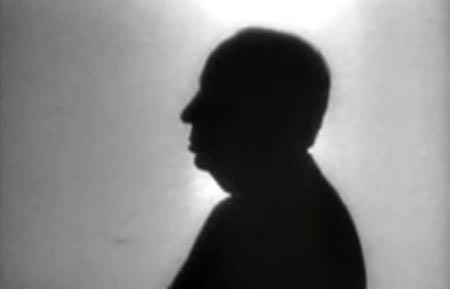
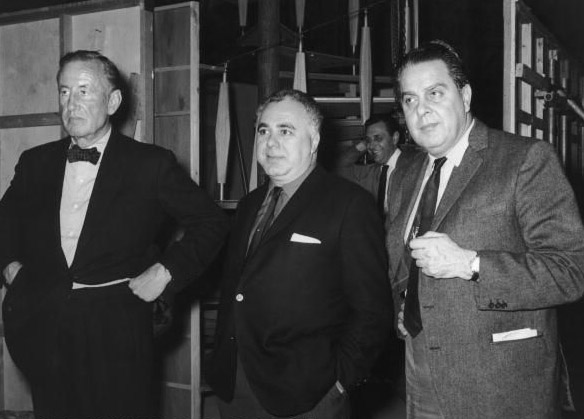
The shadow of Hitchcock hangs heavy over Dr. No, and not just in a literal sense. With the Master of Suspense having been sought as the perfect director for the Thunderball project, it seems inevitable that there would be a resemblance between his work and any consequent James Bond film. North by Northwest is very much the codifier for many of the secret agent tropes that would later become associated with the Bond films - the suave, charming leading man, the softly-spoken and cultured villain who offers his services to enemy powers, a bracing musical score and stylishly designed opening titles.

Saul Bass was Hitchcock's favoured artist, and his legacy can be easily detected in the animated sequence produced by Maurice Binder. Starting with the famous gunbarrel sequence, with electronic noise and the credit "Harry Salzman & Albert R. Broccoli Present" added to the tracking white circle to leave the ampersand picked out, it segues immediately into a sequence of dots and film strips. Beautiful, elegant, irrelevant, showing its heritage and a sign of the future.
 |
Cary Grant as James Bond.
"They were on their
way to a funeral." |
The film opens with the murder of Strangways, MI6's man in Jamaica, and his secretary by a trio wielding silenced pistols. It is important to watch this in the context of its time - Kennedy is still in the White House, the Beatles were still almost unknown and Vietnam was only a distant blob on the map. Seeing two defenceless people repeatedly shot for no apparent reason would have packed a serious punch at the time, and the level of violence the film permits will frequent this level.
MI6's radio room detects a dead line, and the message goes out that something is wrong. The sight of the inside of Bond's place of work is peculiar, more like an office than a secret organisation. This curiosity is repeated when Bond arrived for his briefing, which appears to indicate that M's office is in rented space inside another building.
Bond is summoned at his club, where his is engaged in a game of baccarat with the beautiful Sylvia Trench, but in a neat trick, we do not see his face until he formally introduces himself to her. That first utterance of "Bond. James Bond", as the theme quietly kicks in in the background, is clearly intended as an iconic moment, and five decades later still packs a punch. Rather more startling is the reveal that Bond carries a business card, which he passes to Miss Trench. A little careless for a secret agent?
Bond's briefing reveals that Strangways had been investigating the "toppling" of American missiles
being launched from Cape Canaveral - a super-topical subject in the year of the Cuban Missile Crisis, so Bond is to be dispatched to investigate his disappearance. First he is to be outfitted with a new firearm - his previous one he apparently wore to the gaming tables earlier.
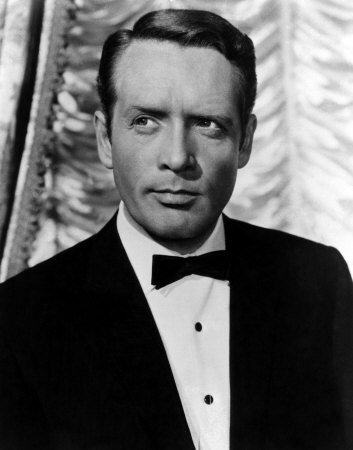 |
Patrick McGoohan as James Bond.
"Tell me, does the toppling of American missiles
really compensate for having no hands?" |
This little scene offers some background to Bond. He has used his current weapon, a Beretta, for a decade, and was previously assigned to standard intelligence duties. M is less than impressed with its tendency to jam, while the armourer flatly calls it ideal "for a woman's handbag". Dialogue also indicates that M has not been long in his post, which might explain his obvious dislike of Bond, something that was not noticeable in the books.
Bond returns to his flat to pack for his mission, but find Miss Trench waiting for him. The shock of actually seeing the inside of Bond's home covers the rather startling matter of Sylvia a) having his address from his business card and b) getting in without any trouble. I appreciate that in olden days people could leave their doors open and not worry about burglars, but spies are traditionally expected to have some security against passing opportunities, especially since Sylvia looks and acts exactly as a honey trap would. Maybe Bond is known as something of a liability, and M wants him in Jamaica where he can do the least damage.
Bond flies to Kingston via that luxury brand Pan Am, presumably served by Christina Ricci on the way, and wanders through the arrivals lounge accompanied by the theme music - the first of a number of inappropriate uses during the film, as though being in an airport were an impossibly thrilling experience. On the other hand, this was 1962. Most people still hid from the Moon.
Bond's driver picks him up, but he quickly deduces that he is an enemy and they have a fight. A poisoned cigarette allows the driver to take the easy way out without talking, much to Bond's surprise, but darker than this is Bond driving up to Government House with the corpse in the back seat and bounding inside, telling the commissioner as he goes "Don't let him get away."
For much of the film, Bond acts more as a detective than a spy, giving him more in common with pulp fiction private eyes than the cliffhanger serial action men or comic-book superheroes he will later more closely resemble. His first suspect to pursue is Quarrel, a local who assisted Strangways in examining offshore islands, and their awkward conversation is unusual for its near-documentary tone.
Monty Norman was hired to provide the music for the film, and based much of it on popular Jamaican rhythms as well as cannibalising a song from an unproduced musical for the James Bond theme. These scenes, of Bond gently questioning and then tailing Quarrel, are notable for their lack of music and restrained sound mix - a major contrast to later example of the genre Bond would spawn. The use of local music, rather than more generic action themes, creates a distinctive atmosphere that in some ways has dated the film, but also allowed it to remain timeless. It exists as an example of a road not taken.
Quarrel turns out to be working with Bond's American opposite number Felix Leiter, so the men pool their resources after a brief fight. One strange detail is comment about Quarrel’s friend Pusfeller, owner of a bar when the men meet. Quarrel mentions that he was tough in the fight as he's used to wrestling alligators. Not, as the book notes, octopuses. At the bar, Bond is filled in on Strangways activities, including stealing some samples from a private island named Crab Key to be tested by local geologist Dent.
Bond spots a woman taking his picture, having previously done so at the airport, and she is intercepted. Quarrel twists her arm to explain who she is, but she does not relent. Again, the violence on display is tough for its time, especially Quarrel’s casual suggestion that he break her arm. In light of Sean Connery's comments in favour of a little domestic violence now and then, this is uncomfortable viewing. Bond muses that whoever is behind matters must be very intimidating to provoke one employee to suicide and another to a broken arm, wondering what there can be on Crab Key that is so valuable. Leiter says that there is little other than a bauxite mine operated by the island’s owner - a certain Doctor No.
Bond visits Dent to ask about the samples, but he says that they were just worthless rock and has since disposed of them. Unconvinced, he uses a Geiger counter the size of a suitcase to test the floor of Quarrel’s boat and deduces - more detective work again - that the samples were radioactive. Someone is operating a large scale nuclear reactor at Crab Key.
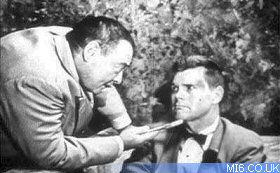
 |
He has people killed by locking
them in and waiting for it to rain. |
Dent, sweating more than ever, takes a boat to the island where he is shown into a room seemingly annexed from a silent German horror film. This is first true sign of the signature James Bond set design, courtesy of Ken Adam, with Dent perched on a chair in the room's furthest corner - all the better to make him seem small and weak. He discusses Bond's progress with a softly-spoken off-screen presence and is given a large poisonous spider to use for his assassination.
The expressionist style of this set reminds one of such works as The Cabinet of Dr. Caligari, but more of Dr. Mabuse. Essentially a nightmarish German version of Professor Moriarty, Mabuse was the emperor of global crime, controlling a seemingly bottomless empire. A modern-day analogue would be that of Keyser Soze - the near-mythical crime lord whose underlings would rather commit suicide than disappoint, and whose presence is only suggested and implied.
That night, Bond finds something unwelcome in his bed, but the sharp-eyed viewer will not miss the thick pane of glass between Sean Connery and the spider, due to the actor's arachnophobia. Had the film stuck to the book, Bond would have been menaced by a centipede with enormous pincers crawling towards his groin. After crushing the spider with his shoe, Bond goes into his en suite. The reason for this in the novel is simple - there are insect guts all over the carpet and he needs to throw up.
Having discovered that the files on Doctor No and Crab Key are missing from Government House, Bond decides the best course of action is to make a date with the secretary at the isolated house. No wonder M's suspicious about him. Bond gets another rendition of his theme as he drives around the countryside, but converse to expectations this cuts out as he finds himself pursued by the silencer gunmen. A flick of the wheel sends their hearse over a steep drop, where it bursts into flames for no apparent reason. The killers' choice of a hearse allows Bond a further black punchline - "They were on their way to a funeral."
Having arrived at Miss Taro's bungalow - giving us another rendition of the theme - Bond turns on the charm and talks her into bed in only a few minutes. Again, the surrounding circumstances would blot out this feat, namely that Bond is kissing, with no little enthusiasm, a mixed-race woman. Shocking stuff for 1962, I imagine. Bond checking his to see if he has time for a quick is less than chivalrous.
 |
| Not pictured: Bond jumping up and down on his head. |
As if we hadn't guessed, Miss Taro is working for Dr. No, and the police take her away leaving Bond to wait for another attempt on his life. Dent turns out to be less than up to the job, emptying all six shots into a pillow and allowing Bond to return the favour. In the finished version of the film, Dent is only shot twice, but the original version sees Bond empty his gun into the prone geologist's back. Perhaps a little too far that time.
Bond and Quarrel set off for Crab Key, as the story shifts gear from part-travelogue, part-detective story to something akin to a paranoid thriller. Quarrel drinks for courage, which is a delightful racial stereotype, while Bond hears singing coming from over the next dune. The sight is that of Venus rising from the waves in the form of a dubbed Swiss model. Bond actually joins in with the song as a means of announcing himself, which is a pretty smug thing to do. The version of Ursula Andress in her pristine white bikini may be one of the reasons why the Vatican issued a communiqué formally disapproving of the film, although they would probably count themselves lucky they didn’t follow the book, where Honey Ryder wears a belt for a knife - and nothing else.
They seek cover as a boat patrol passes, taking a few potshots at them as they go. Fully informed that Bond is coming, No's organisation seems more monolithic and all-powerful than ever. Adding local folklore that there is a dragon on the island to the mythical build-up that the title character has received would explain why I found the film so frightening when I saw it on Anglia Television in the mid-80s. I distinctly recall being sent to bed early, although I may have been naughty on that occasion, attempting to colour in the wallpaper, perhaps.
Bond's reaction to the story of the Dragon is less respectful than mine was, with the look on his face
indicating that he feels he's surrounded by idiots, or at least people he can patronise for their opinions. He sends Quarrel to fetch his shoes for him before they head inland, passing a skull and crossbones sign on the way, again reinforcing No as more of a force than a person.
Stopping to rest, Honey tells Bond her story, including how a man who looked after her after her father's death raped her and she got her revenge by... putting a spider in his bed. It's hard to see which part of this story worries Bond more, but he shrugs it off with a quip. This puts the film's sexual politics in an odd light. Though violence against women can be justified, as with the photographer, the indication is that the agonisingly protracted death of Honey's rapist was deserved. Again, remember that in 1962, the UK still had a death penalty. Even if rape was not a capital offence, the judgement could be at the time that Honey was serving the public good in shorter order than normal. It's somewhat telling that the scene ends with Honey asking Bond if he is single, and his being rather tongue-tied.
Night falls, and the trio finally encounter the dragon. The image of the strange vehicle in the dark landscape of brush is another intimidating and moody one. The dragon is revealed as an armoured car carrying searchlights and a flamethrower. The latter is used to dispose of Quarrel in suitable grisly fashion before the truck disgorges a number of faceless figures in radiation suits. Bond and Honey are bundled inside and taken inside Doctor No's base. It is at this point that the film makes its final jump across genres, venturing into science-fiction.
Bond and Honey go through decontamination, having been wandering around the island's radioactive environment, and are sent into the heart of the base - a weirdly comfortable spa resort-like group of suites, staffed by cheery nurses that fuss over them and their delayed arrival. Invasion of the Bodysnatchers was a few years distant as they are shown wardrobes filled with clothes that fit perfectly and are invited to dine with Doctor No that evening, just as soon as they recover from the knock-out drops in the coffee they've just drank.
On the way to dinner, Bond reassures Honey that he too is scared, showing that the antagonist’s self-conscious myth-making is getting to him. The same could go for the audience, not knowing what to expect when they encounter the mysterious mastermind who engenders such fear from his own underlings.
 |
Noel Coward as Doctor No.
"You were wondering how much it cost.
One million dollars" |
Doctor No himself finally introduces himself, a full 20 minutes from the end of the film, and it is hard to know what to make of the man. Small, slight and with quiet intense manner, Bond immediately starts ripping the piss. The agent receives his very first dry martini, "shaken, not stirred" - informed perhaps by the staff at Bond's hotel? - and proudly describes how the island set up cost him the gargantuan sum of $10 million, stolen from his previous employers in a Chinese Tong society. This figure equates to a cool $75 million in 2012 money, but the island operation still seems a little more expensive than that. Perhaps No is financing himself with that bauxite mine. In the book, the island's bird population was a rich source of guano, sold on at enormous profit.
Having taken note of No's possession of Goya's portrait of Wellington - stolen shortly before production commenced - Bond continues to try to break his captor's facade with barbed remarks about No's metal hands - the result he says of his own unique experiences with radioactivity, while No boasts of his own employer. SPECTRE is the Special Executive for Counterintelligence, Terrorism, Revenge, Extortion, and No wants Bond to apply for a job, possibly in the acronym department. Bond is less interested in this, provoking No to dismiss him as "just a stupid policeman". This may well hit home, moving Bond to ask if "the toppling of American missiles really compensates for having no hands?" The idea that a Bond villain’s actions are compensation for some other shortcoming will reoccur. No is quick to shoot down Bond's own comments about those believing themselves to be God or Napoleon, but the latter seems rather accurate, what with the prize in his gallery.
Growing tired of his guests, No sends Honey off to "entertain" the guards. The inference is obvious, and Bond leaps out of his chair to defend her as she screams for help. A gun to his head dissuades him from acting further, but this fate seems especially cruel for Honey given her past experience. Given that they know her dress size, why might not they have also overheard her earlier conversation with Bond, tailoring a torture just for her.
This fits with the book's portrayal of Bond's ordeal. He is locked in a cell with a single ventilation grill leading into a maze of eerie echoing narrow tunnels. In the book it is made clear that this is a test to examine Bond's physical endurance, as he is given an electric shock taking off the metal grill before nearly falling to his death, being boiled in a red-hot pipe and then almost drowning. The film makes no comment towards No's sadism, simply forcing Bond to jump through some contrived hoops to escape.
The tunnel exit leads to No's control room and Ken Adam's piece de resistance, the inevitable reactor room set. No is about to topple anther missile, but Bond steals a radiation suit and intervenes, overloading the reactor. Extras mill around as alarms sound and the reactor pool starts to steam, and the audience starts to see where Mike Myers gets some of his ideas. There is another noticeable lack of music as Bond and No fight on top of the platform sinking into the now-boiling pool, with Bond climbing out at the last moment, but No's metal hands fail to find purchase as he sinks beneath the surface, expiring in his radiation suit like so many boil-in-the-bag meals before him.
The book offers a different demise, as Bond commanders a crane on the island's dock as No supervises another shipment of guano, allowing him to slowly dump the contents on the Chinese villain, first immobilising him and slowly letter the pile rise like quicksand until he is completely covered and unable to escape. "You're up shit creek", Bond probably says.
As bits of Doctor No’s base explode, Bond frantically searches for Honey, and some of the minor players are allowed moments in the sun. One beleaguered guard knows nothing and scrambles to get away, while the friendly nurse is dragged from her packing by Bond, who finds Honey staked out over slowly rising inlet. The original intention was for her execution to be by giant land crab, but Honey knew that staying still would act as a deterrent and they would lose interest. The crabs shipped from Jamaica to the studio arrived packed in ice and frozen solid, leaving to half a page being torn from the script. Oddly, there is no mention of her "entertaining" the guards. Maybe the crab spectacle was enough for them and they too became bored and wandered off.
Bond and Honey make their escape in a small boat - whose passengers Bond throws in the sea - as the complex is annihilated by a very large and realistic-looking explosion. They are soon picked up by Felix, who seems entirely unconcerned about the mushroom cloud now hovering over a major British colony, and hunker down in their little craft for a little R&R as the James Bond theme blares a final time and a very brief end credit sequence is accompanied by the bloodied gunbarrel from the opening titles.
So what of the film as a whole? Sean Connery's presence eats up the screen wherever he goes, and Joseph Wiseman is subtly menacing as Doctor No, although the decision to yellow him up for the part could have been avoided since the character is stated to be half-German. The production looks notably cheaper than the smash hits of the time - it cost less than Elizabeth Taylor was paid to star in Cleopatra - and seems much smaller is scope and scale virtually all later outings.
Nevertheless, it is supported by a well-structured script, albeit with a number of holes due to the precedence of crowd-pleasing content over internal logic. The repeated attempts on Bond’s life look a little clumsy, hardly the work of a mastermind like No, while Honey notably performs no function in the script other than to be gorgeous and to avoid having Bond snog Quarrel at the end of the film. It's a promising start, all in all. And takes less time to watch than it took to write this article.
 |
JAMES BOND WILL RETURN
IN
"FROM RUSSIA WITH LOVE" |